Strategic SEO For Fetish & Kink Markets: From Keywords To Conversions
Fetish and kink SEO requires a completely different strategy than mainstream SEO. This guide explains how BDSM brands, fetish marketplaces, and kink platforms can grow through keyword research, technical SEO, content systems, and authority-building strategies designed specifically for restricted adult industries.

Published Date: May 28, 2026
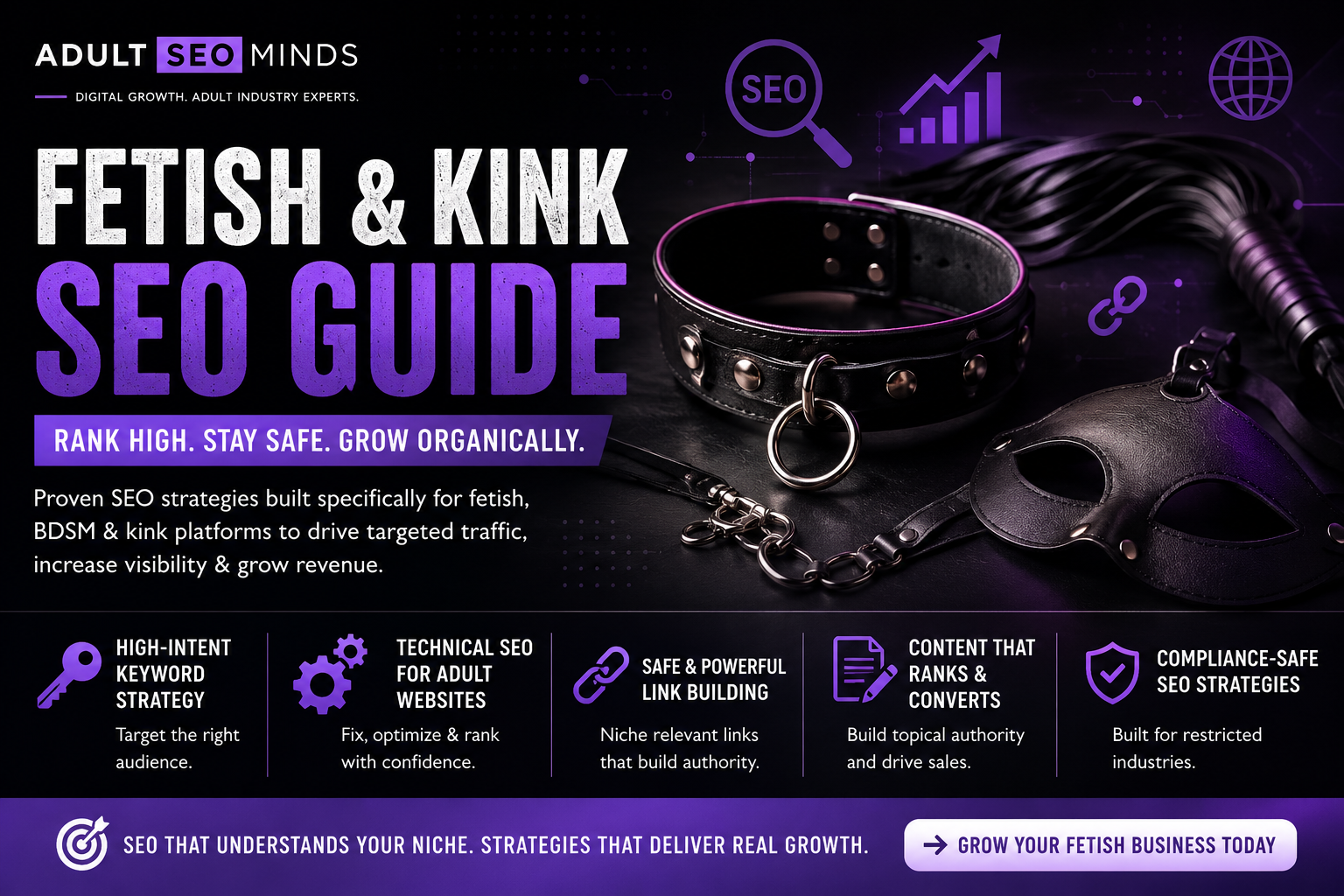
Fetish and kink platforms sit in one of the most competitive and technically demanding corners of adult search. You cannot run paid ads. You cannot rely on mainstream directories. Your entire growth engine runs on organic search, and that means SEO is not a support channel for your business, it is the business. If your platform is not ranking, it is not growing.
Adult SEO Minds specializes exclusively in restricted and sensitive adult niches, including fetish marketplaces, BDSM communities, and kink lifestyle platforms. From technical site architecture to content systems built for conversions, every strategy is designed around long-term ranking stability in exactly the markets this blog covers. Explore fetish and kink SEO services built for your niche.
CTA Heading: Ready to Grow Your Fetish or Kink Platform Organically?
We help fetish brands, BDSM stores, kink communities, and adult platforms build long-term organic growth through technical SEO, authority link building, and conversion-focused content strategies designed specifically for restricted industries.
→ Get Your Adult SEO Strategy CallWhy Fetish and Kink SEO Is A Different Game?
Most SEO playbooks are written for e-commerce or SaaS. They assume you can run retargeting ads to supplement organic traffic, get featured on mainstream press, and submit your site to broad directories. None of that applies here.
Fetish and kink markets operate under a completely different set of rules:
- Search engines flag explicit content categories and apply stricter quality evaluation under YMYL and content policy frameworks.
- Mainstream link building outreach is closed off, so authority has to be built through niche-specific channels.
- Keyword research tools often suppress or misreport search volumes for adult and fetish terms, making standard tools unreliable without adult-specific methodology.
- Content moderation inconsistency means pages can lose indexation without a visible penalty notification.
Keyword Research for Fetish and Kink Niches
Why Standard Keyword Tools Fall Short?
Tools like Ahrefs and Semrush work well for most niches, but they undercount search volume for explicit adult terms because their clickstream data panels exclude or filter adult browsing by default. This means a keyword showing 200 monthly searches may actually be driving 2,000 or more.
The correct approach combines multiple data sources: Google Search Console data from existing pages, adult-specific aggregators, and competitor traffic analysis from platforms already ranking in your niche.
Long Tail Keywords Drive the Most Qualified Traffic
In fetish and kink markets, long tail keywords do not just supplement head terms, they often outperform them. Someone searching “BDSM gear for beginners” or “latex fetish clothing UK” is much closer to a decision than someone searching “fetish clothing.” Long tail terms also face less competition from large tube and streaming platforms that dominate broader queries.
Focus your keyword architecture on
- Preference-specific terms (material fetish, role-based kink, activity-specific terminology).
- Intent-modified phrases (buy, explore, community, guide, beginners, advanced).
- Geography-modified terms for platforms with location components.
How to Target Fetish Keywords Without Getting Your Pages Filtered or Deindexed?
Search engines do not block keywords outright, but pages built entirely around explicit terms with no supporting context are more likely to get filtered or quietly deindexed over time.
The fix is topical clusters. Instead of one isolated page chasing an explicit keyword, build a main commercial page supported by educational and intent-varied content around the same topic. A page targeting “buy bondage restraints” becomes far more stable when supported by content like “what is bondage” and “bondage safety guide.” Together they signal genuine topical authority rather than a thin page targeting a single explicit term.
On-Page SEO for Fetish and Kink Platforms
On-page optimization in this niche requires more precision than standard practice because every element of your page contributes to how search engines categorize and evaluate content quality.
Title Tags and Meta Descriptions
Your title tag should lead with the primary keyword naturally, not stuffed. For a fetish product category page, something like “Latex Fetish Clothing for Women and Men” outperforms “Best Sexy Latex Outfits” both in clarity and keyword alignment. Avoid superlatives and sensationalist language in title tags because search engines use them as a signal of low-quality pages.
Meta descriptions in this niche serve a click-through rate function more than a keyword function. Write them for the user, not the algorithm. Describe what the page delivers and who it is for, clearly and directly.
Heading Structure
Use H1 for your primary keyword, H2 for major content sections, and H3 for sub-topics within sections. Do not skip heading levels. Search engines use heading hierarchy to understand page structure, and a flat or random heading structure weakens topical signals.
Schema Markup
Fetish and kink platforms benefit heavily from:
- Product schema on e-commerce pages (price, availability, reviews).
- FAQ schema on educational and guide content.
- Breadcrumb List schema across category hierarchies.
- Article schema on blog and guide content.
Schema does not directly improve rankings but improves how your content is understood and displayed, which lifts click-through rates from search results.
Off-Page SEO for Fetish and Kink Platforms
Off-page SEO covers everything that builds your site’s authority outside of your own pages. Most mainstream off-page channels are closed in this niche, which makes execution harder but also means most competitors are not doing it well.
- Link building is your strongest lever. Niche directory listings, editorial mentions from adult publications, and partnerships with fetish educators or creators all earn contextual links that carry real authority in this space.
- Brand mentions and community signals matter even without a direct link. Consistent presence across Reddit communities, FetLife groups, and kink-specific forums builds brand recognition and generates organic mentions that accumulate into domain authority over time. Participate genuinely because these communities reject anything that feels promotional.
- Digital PR and social profiles round out your off-page strategy. Earning coverage in adult lifestyle publications earns high-authority links and puts your brand in front of a ready audience. Maintaining active profiles on Reddit, FetLife, and X creates additional indexed brand signals that support overall authority.
Want To Know About Adult Industry SEO Packages: Features, Pricing & Benefits
What to avoid?
Do not buy links from adult link farms, PBN networks, or open-submission directories. Low-quality link profiles are penalized faster and harder in adult SEO than in any other niche.
Content Strategy That Converts
Content in the fetish and kink space serves two distinct audiences at once: search engine crawlers evaluating topical authority and real users who are often navigating sensitive personal interests. Both need to be served simultaneously.
What Type of Content Ranks in Kink Markets?
Educational and informational content consistently ranks well in this niche for several reasons. It attracts high-volume queries, earns links from community resources, and builds the kind of topical depth that supports commercial pages ranking alongside it.
Content types that perform:
- Beginner guides to specific kinks, practices or categories.
- Safety and consent resources (these earn links from educational and health-adjacent sites).
- Product comparison and buying guides.
- Glossary and terminology pages (excellent for capturing definitional and educational queries).
- Community-focused content that answers real questions from within the lifestyle.
Balancing Explicit and SEO-Friendly Content
This is one of the most common strategic mistakes in fetish and kink SEO. Platforms often go all-in on explicit content without building the informational scaffolding that earns topical authority, or they bury their commercial pages so deep in educational content that conversion suffers.
The right balance looks like this: build a strong informational layer that ranks for educational and research-stage queries, then use internal linking structures to connect that traffic to conversion-focused pages. A user reading “how to choose a BDSM starter kit” should have a clear, natural path to the product category you want them to buy from.
Check: Adult SEO Strategies for Porn, Escorts, Dating & AI Sites
Technical SEO Checklist for Fetish and Kink Sites
Technical issues hit adult sites harder than mainstream ones because search engines already apply stricter quality thresholds. A crawl problem that costs a mainstream site 10% traffic might cost an adult site 40%.
Key technical areas to audit and maintain:
1) Crawl budget management
Large fetish platforms with thousands of product and content pages need to control what gets crawled. Use robots.txt and canonical tags deliberately to concentrate crawl equity on high-value pages.
2) HTTPS and secure connection status
Non-HTTPS pages face immediate trust penalties in the adult space.
3) Page speed on mobile
Fetish and kink audiences skew heavily toward mobile browsing. Core Web Vitals issues on mobile disproportionately affect this audience.
4) Indexation monitoring
Pages can drop from the index without a manual action notice. Set up regular indexation checks via Google Search Console.
5) Canonical tag accuracy
Fetish e-commerce platforms often create hundreds of near-duplicate pages through filter combinations. Every non-canonical page needs a correctly pointed canonical tag.
6) Age verification implementation
Incorrectly structured age gates can block crawlers entirely. Implement age verification in a way that remains crawlable for search engines while being legally compliant.
7) Structured internal linking
Build clear category silos with consistent internal linking so authority flows from your strongest pages to your most commercially important ones.
Converting Organic Traffic Into Paying Customers
Ranking is the first problem. Converting the traffic you earn is the second problem and it is just as important.
Understanding the Kink Audience’s Purchase Journey
Users in fetish and kink markets often go through a longer research phase than typical e-commerce buyers. First-time visitors are frequently exploring, not buying. They need trust signals, clear information, and a non-judgmental tone before they are ready to convert.
This means your conversion optimization needs to account for:
- Trust signals specific to the niche (discreet packaging and billing, privacy policy prominence, community credibility).
- Multi-session conversion paths (most buyers do not convert on their first visit).
- Content that meets users at the research stage and earns return visits.
Read More: How to Register and Grow a Legal Porn Company
Landing Page Structure for Fetish and Kink SEO
Each landing page should answer a clear intent: what the user is looking for, who it is for, and why this platform is the right choice. Category pages on fetish platforms that also include a short educational introduction consistently outperform pure product grid pages in both ranking and conversion rate.
Place trust signals, social proof, and clear purchase pathways above the fold. In this niche, users need to feel safe and understood before they will hand over payment information.
Conclusion
Fetish and kink SEO is genuinely one of the most challenging areas to execute well, but it rewards specialists who understand the environment. Standard playbooks fail here because the advertising, link building, and content rules are all different. Platforms that invest in proper keyword architecture, niche authority building, technical health and content systems designed for both ranking and conversion are the ones that own their markets long-term.
The organic channel is not a backup plan in this niche. It is the only plan. Getting it right means building every layer of SEO with precision, patience and a clear understanding of exactly where your audience is and what exactly they are searching for.
Frequently Asked Questions
Yes, organic search is the primary traffic channel for most fetish and kink platforms precisely because paid advertising is restricted, and many sites in this niche generate significant revenue entirely from SEO.
Most fetish and kink platforms begin seeing measurable organic growth between four and eight months, with more competitive keywords taking twelve months or longer to achieve stable top-ten positions.
Guest posting works in this niche but only on genuinely relevant adult and kink-positive publications. Generic guest post networks are high-risk in adult SEO and should be avoided.
Extremely important. A significant majority of fetish content is consumed on mobile devices, and Core Web Vitals performance on mobile directly influences rankings for this audience.
Not directly as ranking factors, but consistent presence in relevant communities drives referral traffic, brand mentions, and indirect link acquisition that all contribute to overall domain authority.
Table of Content
- Why Fetish and Kink SEO Is A Different Game?
- Keyword Research for Fetish and Kink Niches
- On-Page SEO for Fetish and Kink Platforms
- Off-Page SEO for Fetish and Kink Platforms
- Content Strategy That Converts
- Technical SEO Checklist for Fetish and Kink Sites
- Converting Organic Traffic Into Paying Customers
- Conclusion
- Frequently Asked Questions